The short answer: partial replacement is the right scope when the old wiring is confined to circuits you can name, those circuits can be fully replaced from end to end, and the rest of the house is sound, grounded and protected. Widespread original wiring or questionable alterations call for a broader evaluation; the actual defects and any written insurer or lender conditions determine whether whole-house replacement is warranted. A panel replacement or service upgrade is a third, separate decision that attaches to either. This page gives you the test, shows how the two kinds of wiring coexist in a real house, and compares the three scopes side by side.
The five-question test
Answer these with an electrician at the panel, not from the inspection report. All five conditions in the first group need to be considered together; they are not a score. The second group identifies reasons to investigate a broader scope, not automatic proof that every circuit must be replaced.
Partial replacement is likely enough if:
- Circuit tracing shows the old wiring (knob-and-tube, ungrounded cloth cable, aluminum) is on a minority of circuits, and you can list them.
- Each of those circuits can be replaced from the panel to every device on it — no stretch of old wire would be left feeding anything.
- The remaining circuits are modern grounded cable in good condition with properly rated breakers.
- The panel is a sound breaker panel with capacity for the replacements.
- Your insurer and lender accept “energized old wiring removed; sound later circuits remain,” documented.
Investigate whole-house rewiring when:
- Most circuits are original, or you can’t tell which are and which aren’t without opening more walls than the rewire would.
- Multiple undocumented or improper connections join old and new wiring; further investigation is needed to establish circuit condition.
- Attic knob-and-tube is energized under insulation and feeds more than one area.
- The panel is a fuse box, is over-fused, or has documented defects, and the branch wiring also shows widespread problems. Panel condition alone does not establish the branch-circuit scope.
- The requirement from outside — insurer, lender, buyer — is “no knob-and-tube remaining,” with no partial-credit option.
- You’re opening walls for a remodel anyway.
A reputable bidder will tell you which group your house is in and why, and should be willing to price both.
How old and new wiring coexist in one house
An older house can contain multiple wiring types after past alterations. That mix does not by itself establish safety or code compliance. The electrician must check the condition of each circuit and the way different wiring methods connect. Concealed, inaccessible or improper splices require attention; a properly designed accessible junction is a different condition.
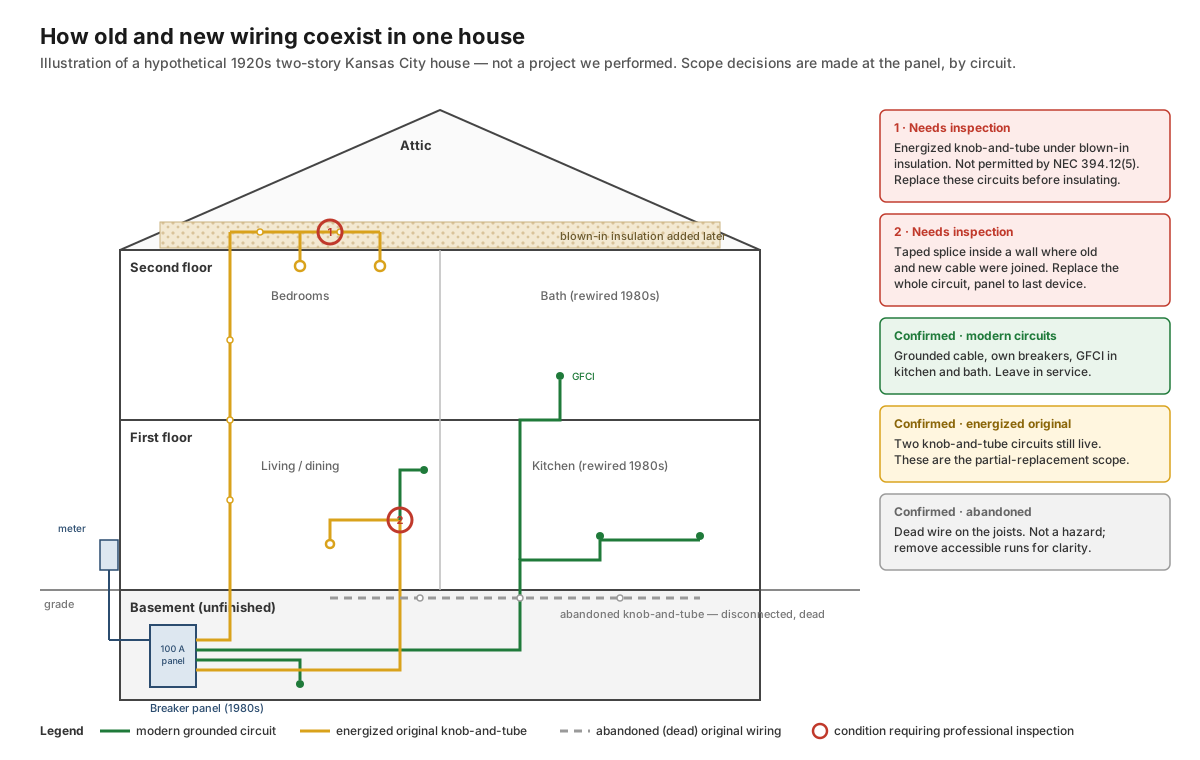
Hypothetical house, for illustration. Colors: green = modern grounded circuits; amber = energized original wiring; grey dashed = abandoned (dead) original wiring; red marker = condition that needs professional inspection.
Read the picture from the panel outward:
- Trace beyond the panel. The wiring visible at a breaker does not establish the wiring type for the entire circuit. The 1980s breaker panel feeds the kitchen, bath and basement on modern grounded cable, and it also feeds — on their own breakers — the two original knob-and-tube circuits that still serve the second floor. That is a partial-replacement candidate if inspection also confirms the retained circuits are suitable and the proposed scope meets any insurer or lender conditions.
- Document abandoned wiring. The grey dashed wiring in this hypothetical diagram is disconnected. An electrician must establish that status in a real house; appearance alone is not enough. Agree which accessible sections will be removed and whether concealed disconnected sections may remain, subject to the inspector and any insurer or lender conditions.
- An improper concealed splice needs correction. The red marker on the first floor is where someone extended an original circuit with modern cable at a taped joint in a wall cavity. That connection needs professional evaluation and correction. Its presence is a reason to examine other alterations, not proof that every circuit has the same defect.
- Attic wire under insulation is a priority regardless of condition. The NEC prohibits energized knob-and-tube in cavities insulated with loose, rolled or foamed-in material that envelops the conductors (NEC 394.12(5)). If the attic was insulated after the house was wired — very common in houses insulated after the late-1970s energy programs — the attic circuits lead the scope.
What this means for the decision: the question is not “how old is the house” but “how many circuits cross the boundary cleanly.” Two isolated original circuits may support a limited scope. Widespread original wiring and poorly documented alterations justify broader investigation even when one room appears updated.
The three scopes, side by side
| Partial replacement | Whole-house rewiring | Electrical service / panel upgrade | |
|---|---|---|---|
| What is replaced | The specific energized old circuits, panel to last device; accessible dead runs removed | Branch wiring throughout; list boxes and devices replaced or suitably retained | Meter base, service-entrance conductors, mast/lateral, main disconnect, grounding, panel — not the branch circuits |
| What is left as-is | Sound modern circuits; the panel if adequate | No original branch wiring in service; suitable boxes/devices and service equipment only as stated in the scope | All the wiring in the walls |
| Reasons to evaluate | Defects or old wiring confined to identifiable circuits; suitable retained circuits | Widespread deficiencies; comprehensive replacement required by project or written loan/insurance condition | Equipment condition, insufficient compatible breaker spaces, or a load calculation showing inadequate capacity |
| What it does not achieve | A “fully rewired” house for an insurer/buyer with a strict rule | A new service — it’s separate | Any change to old branch wiring; a panel upgrade alone leaves knob-and-tube exactly where it was |
| Code work to confirm | Protection, device types and layout for the actual alterations | Protection, device layout and required dedicated circuits under the adopted code | Service-equipment, grounding/bonding and emergency-disconnect requirements (local editions) |
| Permit | Yes — every KC-area jurisdiction checked | Yes | Yes; plus utility coordination |
| Inspections | Rough-in + final | Rough-in per phase + final | Final + utility release (BPU and IPL require inspection approval before energizing) |
| Wall disruption | Affected rooms and any access along the cable routes | Access throughout; openings depend on existing routes | Equipment area and service route; confirm interior and exterior work |
| Occupied house | Confirm safe occupied areas and outages | Agree phased access, containment and outages | Utility-coordinated outage; duration confirmed for the project |
| Documentation at close | Permit, final, invoice naming replaced circuits and circuits still on old wiring | Permit, final, invoice stating no original wiring remains in service | Permit, final, utility release |
| Combine with | Panel work if condition, compatibility or spaces require it | Panel work as needed; increased service amperage only when justified | Either branch-circuit scope |
A downloadable version is at /assets/scope-comparison-table.pdf. Use the project proposal for the actual schedule and outage plan.
Phasing: the legitimate middle path
Room-by-room or floor-by-floor phasing is a reasonable way to do a larger project in planned stages — with two conditions. First, the phases are planned as one scope, so nothing gets spliced to “temporary” old wiring between phases. Second, each phase is permitted and inspected (or the permit is kept open and inspected per phase, where the city allows). Phasing may add repeated setup, inspections and temporary arrangements, and it keeps some old circuits in service longer. Compare a phased proposal with a continuous job and confirm that either sequence satisfies insurer or lender deadlines.
What each scope leaves behind for the next owner
After a partial replacement, the remaining wiring and any abandoned conductors should be clearly documented. A later inspector may still note visible knob-and-tube, and an insurer may request clarification. The documentation at close — an itemized invoice naming which circuits were replaced and which remain on old wiring, plus the permit and final inspection — helps explain the completed work but cannot guarantee how a later buyer or insurer will respond. A whole-house job leaves an invoice that says “no original wiring remains in service,” which is a different asset. Compare like-for-like proposals to learn the price difference for your house. The cost guide separates contractor-published ranges from homeowner anecdotes; those different houses cannot establish a partial-versus-whole price gap.
Frequently asked questions
Can I just replace the knob-and-tube in the attic and leave the rest?
If the attic circuits can be replaced end to end and the rest is sound, yes — that’s a partial replacement, and attic-under-insulation is the right place to start. If the attic runs feed circuits that continue into walls and get spliced to newer cable somewhere, the “rest” isn’t separable.
Is it safe to leave dead knob-and-tube in the walls?
An electrician must verify that the old conductors are fully disconnected from all sources. Ask the local inspector whether concealed disconnected wire can remain for this project, and document what remains so a later inspector or insurer can understand it.
Does a panel upgrade fix knob-and-tube?
No. A panel upgrade replaces the service equipment; it doesn’t touch the wiring in the walls. A new panel can still feed original circuits. Evaluate the branch wiring separately instead of treating the panel date as evidence that the house was rewired.
Will a partial replacement satisfy my insurer?
Clarify whether the carrier wants particular defects corrected, all energized knob-and-tube taken out of service, or physical removal of remaining wiring. Ask the agent for the carrier’s position in writing before choosing the scope. See buying a home with knob-and-tube.
Which scope is cheaper per circuit?
There is no dependable per-circuit ordering from the sources reviewed. Shared setup may reduce some costs, while inaccessible routes, circuit length, devices and inspection requirements can change the comparison. Ask for itemized proposals for the actual alternatives. The estimate worksheet lets you see the per-scope difference between bids.
Want both scopes priced for your house so you can decide on real numbers? Get a Quote. The service pages: knob-and-tube replacement (partial and room-by-room scopes included) and whole-house rewiring. For everything else — wiring types, permits, plaster, insurance — start with the complete guide to rewiring an older Kansas City home.